Perhaps you want to offer the course material to anyone interested. In this case you just put your material to the website and make it publicly available. This is the default.
Only if you want to know your students personally, you will ask them to register for the course. From our experience, it is not a good idea to offer a self-registration form on the website. The website will receive many registration attempts by malicious software robots who want to enter the site to check for security vulnerabilities or who distribute spam.
My suggestion is to put an email link to the event announcement, so that interested people can send an email to you and you register them.
Overview of Joomla user management
Let's consider a scenario where you have invited a group of students and want to offer an online course to them, and to them only. You have created course material on a couple of web pages. As you know, in Joomla web pages are called 'Articles' which are organized in 'Categories'. Access to all articles of a category is controlled by an 'Access Level'. Articles are visible only to those users who belong to a user group which is granted the correct access level.
To summarize the workflow, here are the main steps:
Create a category for your course and assign this to all course articles.
Create an 'Access Level' named after your course. In your category settings, restrict access to that access level.
Create a website user group named after your course. The user group should be a child group of the group 'Registered'. Associate this group with your access level.
Register your students as 'users' on the website and as members of your user group.
Questionnaires
You can interact with students using questionnaires. There is a component on the backend where you can create and manage quizzes, tests, or surveys. This demo shows how to create a questionnaire:
Quiz: Internet, World Wide Web, Client-Server, URL, IP addresses, Internet security
3 From passive to active: Content creation
Accessing the server, Login to the backend
Exploring the Joomla backend
Articles, categories, tags, modules, menus
Joomla Extensions
Quiz: terms from the Joomla backend
Presentation of the 'playground'
Workflow demo: Create an article and make it visible in the frontend
Playground exercise: Students create a 'Greeting' message, which shows after clicking on the 'Greetings' menu item
4 Adding bells and whistles to an article
Images, Links, Buttons, Headers, …
Workflow demo
Playground exercise: Publish a blog article about a topic of your choice, with a link and an image.
5 Create a dedicated WDU section for a lecture/seminar/course
Initial considerations about the sections' organization
Extensions: Forum, quiz, video, …
Preparing the content: Articles, documents for download, …
Setup menus, modules, categories
Create articles
Workflow demo: WDU seminar example
Playground exercise: Setup a workshop section (separate category, announcement as blog article, report with video link and link to other files in the Activities section, module with a teaser on the home page)
6 Manage students
When and why is enrolling to an event needed?
Overview of Joomla user management (roles, rights, groups)
Workflow demo: Granting students the right to access a course
7 Wrapping up
Summary: What we learned so far
Survey: Self-assessment: Do I feel safe in applying what has been learned? What is still difficult? Which topics I like to understand better? Is content creation something I like to do?
You want to offer a WDU course but are not sure how to make it available online at the WDU website?
This course is for you! In seven easy steps it shows how to post your course material on the Joomla-powered website and how to make it available to your students.
.
Schedule: Fall 2022
Instructor: Uli Spalthoff
To register, please send a message to This email address is being protected from spambots. You need JavaScript enabled to view it..
Login Form
Quotes
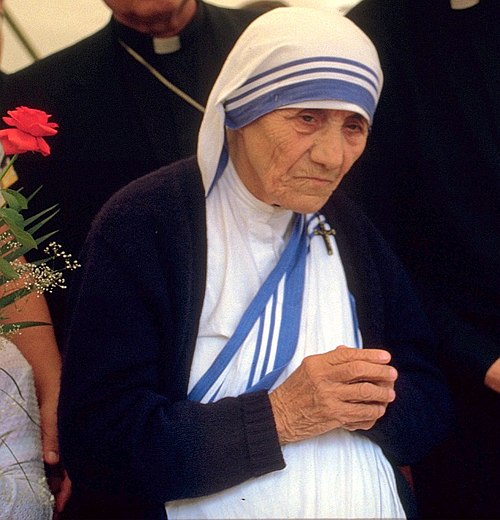
Mother Teresa
Image credit: commons.wikimedia.org
Poverty doesn´t only consist of being hungry for bread, but rather it is a tremendous hunger for human dignity.
Mother Teresa Her essential wisdom, edited by Carol Kelly-Gangi, Fall River Press, New York, 2006 , p. 31 (found by Francisco Cardoso Gomes de Matos)